Phoenix Slides Lives!
I’m happy to announce that a new version of Phoenix Slides has been released!
I’m happy to announce that a new version of Phoenix Slides has been released!
 If you go to Maui, you will probably go visit Haleakalā National Park. At the top of the 10,000ft volcano is a little basin filled with cinder cones, or puʻu. There’s no other place in the world quite like it.
Being forced to change servers has finally given me the kick in the butt I needed to revamp my web site and blog. The change is long overdue… Movable Type stopped being open source in 2013(!), and trying to keep any server side software operational became an exercise in frustration since every server upgrade broke all my scri...
If you look at the latest release of Phoenix Slides, you might get the impression that the main purpose of the update is to update the updater. You would be correct! But I promise it’s for a very good reason.
If you watch Coco in Spanish and turn on the Spanish subtitles you might notice that they don’t match up. Apparently this is because the Spanish audio track is created to match up with what’s going on on screen (including the mouth movements of the characters), whereas the subtitles are translated from the English dialogue.
 On Sunday, December 9, my friend Rosemary and I decided to go to a place neither of us had been before: a national park located entirely within the boundaries of Mexico City called Desierto de los Leones. According to Lonely Planet, there are hourly buses leaving from Viveros Metro station, in front of the 7-Eleven, which tak...
Here is a rather hilarious excerpt from Y. R. Chao 1916, “The Problem of the Chinese Language”, The Chinese Students’ Monthly, 11:7-8. I think this was Y. R. Chao’s first article in English.
I imagine it’s like sitting on a plane. That’s what I imagine for my mom’s final hours.
While reading up on Macklemore’s song “Same Love”, I came across an article on the Huffington Post which says that Macklemore’s “four ‘hella gay’ uncles were an influence”:
It’s been over two years since my last entry, which I think can be blamed on the craziness of the last year of writing a dissertation and the ensuing craziness of being jobless and then finding a job and moving three times within the space of a year. That, and the existence of facebook status updates. I think there’s still a ...
I just saw a commercial on the local Liangshan TV channel that literally made my jaw drop. The overly dramatic announcer proclaims: 一个小板凳,一个大工程 “One Little Stool, One Big Project”. I can’t find the commercial itself, but here’s the first google hit for “凉山 一个小板凳”.
 In China it seems de rigueur to use Tibetan-looking fontified Chinese characters to make posters and book titles, etc., about things related to Tibet. I’ve always found this practice to be vaguely offensive, perhaps because of the “chopstick” font that you see sometimes on Chinese restaurant menus. (You know, the kind that’s...
January 25. Getting off the train at Xichang (西昌) at 5am, I see a white girl. WTF? So I’m all, hey, where are you from? She says in Mandarin, Gélìxī. I think to myself, is that even a country? She must have read my mind, since the next thing she said was “it’s in Europe,” in Chinese. Oh, ok. I told her I was from San Francisc...
 first day in hong kong, i’m lazing around surfing the internet thinking “why am i lazing around surfing the internet when i should be wandering around outside?” when i come across the news that there’s totally A SOLAR ECLIPSE visible from Hong Kong AT THAT VERY MOMENT. It’s only a partial eclipse here, but still… “So that’s ...
As wonderful as BibTeX is, it’s always bothered me that it formats non-initial names as “First Last” even when they’re Chinese names (or Japanese, etc., but most of the citations I use are Chinese), which customarily put the surname first. “But how would BibTeX know that the name’s Chinese?” you ask. Actually, it’s nothing ma...
One of the terms that’s always confused me in linguistics is that of languages being genetically related. Linguistic relatedness doesn’t necessarily have anything to do biological relatedness, so why use this term?
 [Guest post by Andrew]: While walking along Waikiki Beach, I was struck by the large numbers of people carrying flyers advertising indoor shooting ranges. The predominant language in all of these flyers was Japanese (see image for a representative sample). The people passing out flyers were clearly profiling - aiming for Jap...
I recently stumbled across a romanization system for Cantonese called Pênkyämp (which, amazingly enough, is supposed to be pronounced [pʰɪŋ³³jɐm⁵⁵], or “ping yum”, for the non-IPA-readers). Yes, it is even discussed on mainland bulletin boards and promoted in blogs. Pênkyämp is, hands down, the most confusing Cantonese roma...
The Yi (Nuosu) script is crazy! I’ve been trying to learn Nuosu, and have made a handy reference chart (inspired by the jiǎnzhì 简志, which has a foldout chart in the back).
 While at the Korean Bell of Friendship in San Pedro, I saw these two wooden figures that had written on them 天下大將軍 and 地下女將軍. (They also look like they’ve seen better days.) I was puzzled, took a picture, and now have looked them up on the internet.
I’ve been reading Traveler’s Tales: Tibet (link to Google books), and I must say it has some pretty incredible stories… I recommend!
I’ve been going through an old book entitled Everybody’s Cantonese (1949, by Chan Yeung Kwong), and although the vocabulary is pretty basic, I did find some old pronunciations and interesting characters. For example, 咁 is transcribed as gom3, with a back rounded vowel (nowadays usually pronounced gɐm3); and 粒 is transcribed a...
i finally got an intel mac, and i’ve been spending part of the last few days reinstalling files that didn’t get transferred automatically. Imagine my horror when i opened my web page and discovered that the font had suddenly turned ugly! what had happened to my beloved charcoal font?
The newspapers are making a big deal about how the mainland translation skips out on “communism” and “dissent”, which got me looking for the full, uncut translation from Hong Kong-based broadcaster Phoenix Satellite Television, which is mentioned—but, rather inconveniently, not linked to—in the English-language media. So I ex...
Having been surrounded by Asian American people all my life, I’ve been kind of shocked at how white grad school is. My house has almost 60 people, and last semester there were around 6 including me, which is an increase from previous years. My department has the same ratio: about 6 Asian Americans out of almost 60 grad studen...
 One of the things that always bothers me about mainland China are the weird usages of certain words. Take 文化 ‘culture’, for instance. If someone here says that someone “has culture” (有文化), what they really mean is that they’ve been educated. Having taken, e.g., Anthro CIV my freshman year, this is totally bizarre to me. Ever...
Listening to my field recordings, it’s kind of amazing how much better I can understand the Sichuanese Mandarin that my consultants spoke now (compared with when I first got there in June). Simple things like [m̩˩ te˦] ‘no’/’not have’ (compare with Standard Mandarin méiyǒu 沒有). It’s hard enough understanding a different dial...
 what has dominic been up to in the last two months don’t look at me, i just sit on his desk all day
 If you’re in the Tsim Sha Tsui area of Hong Kong and need to eat, I highly recommend 洪利粥店茶餐廳 (Hung Lee), on Hau Fook Street 厚福街, which is not on the tourist map but is right in between Granville and Cameron, off of Carnarvon.
Anticipating my Guangzhou metro trip in a couple days (the machines only take 1-kuai coins, not bills), I asked if they had coins at the counter after having dinner. “冇啊,” she said. “有嗰陣時又冇人要。” (“No, and when we do no one wants them.”)
 Here’s a lovely little supermarket logo. I think it’s a person on a bike. The unfortunate part of it is the string of letters of along the top, which seem to make no sense at first glance. Guess what the letters SCSHHSYYXZRGS stand for… (scroll down for the answer)
Today I went to the Sichuan University Museum, which, according to reviews, is one of the better museums in the southwest of China, with a good ethnographic section. Peh! This does not make me want to visit other museums in southwest China.
There is a brief moment of levity at every bus stop in Chengdu, when the name of the stop is announced (prerecorded) in both Mandarin and English. The English version is the following: “Now. [insert name of stop in Mandarin here].”
If you ever need to add passport pages, I highly recommend doing it abroad, where they do it while you wait. Every page of my passport has now been stamped or visa’d, so I went to the consulate here in Chengdu, which (after getting past the security) was an extremely pleasant experience, since the waiting room was air conditi...
I’ve been doing a lot of transcription on the computer lately, and my left elbow is starting to bother me again. I think I have to switch to paper transcription. If only there was handwriting recognition that recognized IPA! Computer technology just isn’t “there” yet; we have to adapt ourselves to computers, when it really sh...
In the town I’m in (Mianning), there’s been a particularly disturbing and/or hilarious sound change in their variety of Southwestern Mandarin, namely /ʂw/ > /f/, the result of which is that, e.g., ‘drink water’ (喝水) is /xo⁵⁵ fei⁵⁵/, ‘fun’ (好耍) is /xao⁵⁵ fa⁵⁵/, and ‘read’ (看书) is /kʰæn²¹ fu⁵⁵/.
I confess… my guilty pleasure here is the National Geographic channel. (Actually, English-language TV in general, but the other two channels are movie channels and the movies are usually a family affair. Hot Fuzz is a great movie, by the way.) Last night I watched “Whitewater Kayak China”. It was definitely superficial on the...
There is exactly one travel agency here, and I went there today to buy a plane ticket from Chengdu to Guangzhou. I was originally going to take an overnight train from Kunming, but my plans now require going back to Chengdu first, and a train from there to Guangzhou will take something like two days—too long to be trapped in ...
On the other hand, it’s very beautiful here… (this is a 360-degree pan… if anyone knows how to clean up the boundaries i’d appreciate help!)
The TV is on pretty much all the time here. Today I had some TV time to myself, during which time I discovered the National Geographic Asia channel. To celebrate ten years of “Nat Geo in Asia”, they were counting down the top 30 documentaries. The one I saw was about how bees are disappearing. CCD is what it’s called—Colony C...
In high school my online friends would joke about experiencing withdrawal after not logging on for a day or two… It’s been almost a week for me, and I suppose I am experiencing somewhat severe withdrawal symptoms. At night I’ll have dreams of easy internet access, like an ethernet jack in the hotel room (“Why didn’t I notice ...
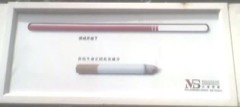 Ran across this one this ad this morning on the campus of the Southwest University for Nationalities 西南民族大学. Using a video game metaphor, it says, 游戏开始了 / 你的生命正因此减少 “The game has begun. Your life is reduced because of this.” Again, it’s refreshing to see things like this, compared with the old man on the boat six years ago, ...
While eating 水饺 for dinner, I realized that I don’t like expensive food. Twelve 水饺 with 白菜肉 filling (dumplings with meat and lettuce, I think… I think 白菜 in these parts is not the same as the bok choy we are normally familiar with) cost 3 kuai. Three kuai! And they were good! Of course, I am partial to delicious bits of meat ...
 Here’s a sign, bilingual in Tibetan and Chinese, advertising new phone numbers: ཁ་པར་ཨང་གྲངས་གསར་པ་བཙོང་རྒྱུ་ཡོད།
 Please take the initiative for being old, weak, ill, incomplete, pregnant and offering one’s seat.
 Today I had lunch with some friends at this Shambhala Tibetan Restaurant ཤམ་བྷ་ལའི་བོད་ཟས། in the 武侯祠 district. We had tibetan tea and yogurt and groma གྲོ་མ་ (a beany kind of root, 人生果 in Chinese) and momos.
WHAT’S THE POINT of having separate “smoking rooms” in between the trains if all the windows are closed and all the smoke wafts back into the cabins anyway?????????
 I know I’ve seen this on the web before, since it’s located in the foreigner-heavy district of Cháoyáng 朝阳, specifically Jiànwài 建外 (short for 建国门外, outside the Jiànguó Gate). It’s still hilarious, though.
 The magnitude of the Beijing West Train Station is not done justice by this photo, which only catches the middle of it. There are 38 or so ticket counters on the first floor, which you have to x-ray your bags to even get into. Counter number 1 promises an English-speaking clerk, and the last counter sells 1-kuai tickets to p...
 I’ve been somewhat pleasantly surprised by various things in Beijing. One interesting thing was this reusable shopping bag. The lettering says ‘For a caring life / 环保”袋”回家’, (environmental “bag” it home, where “bag” dài is a pun on ‘bring’). So even though the streets and rivers are filled with trash, there is a growing awar...
 Here’s another pleasant surprise (I’m actually writing this after the next entry about the reusable bags)… Signs encouraging people to line up. 自觉排队 礼让光荣 - “Take the initiative and line up; politely yielding is glorious.”
The best part of China is cheap breakfast. Mmm… 馅饼 (pancake-like things with various kinds of stuff sandwiched inside) for 1 kuai, 包子 (buns with various kinds of stuff stuffed inside) for 0.5 each, soy milk for 1 kuai a cup, and not that disgusting thick stuff they sell to white people in the U.S.
it is my first day in beijing, and the two main impressions i have are these: first, the air is really bad. The pollution is bad, for one, but the even more distressing (to my eyes - literally) is how sandy/dusty the wind is. it’s huge. The city is big, the streets are big, and it takes a long time to get anywhere.
i hate that question. But thanks to Kevin C., I have an answer.
It’s always interesting when you learn a character for a word you know but didn’t know had a character. Especially when it’s super-complex. Take, for example, Cantonese zok6 ‘chisel’:
Here are some characters that look alike. 戊 wù/mou6 ‘5th of the 10 Heavenly Stems’. Originally a picture of an axe-like weapon. Used as phonetic in 茂 mào/mau6 ‘luxuriant; profuse’.
Since I had backed up everything for the hard drive upgrade, I decided to upgrade to OS X 10.5 (Leopard) while I was at it. I’d been waiting to upgrade, just to see what everyone else’s problems and gripes were, and to wait for the instabilities to settle down, and to copy over some data I still had in a HyperCard stack. That...
To increase my geek points, I decided to replace the hard drive in my powerbook. I am happy to report that the operation was a success! It’s gone from 80 to 160 GB. (I followed the instructions at ifixit.com, and benefited from the comments on this blog:)
so I think I got comments working here… so if you’re reading this, please post a comment to test it out! (it’ll make me feel important)
Brushing up on my Chinese, I came across this character: 躍. “I wonder how you pronounce it,” I said to myself, and tried to look it up under pinyin yào, since it shares the phonetic with 耀 ‘shine’. No dice.
I spent today converting my old blogs to this nifty new system. The main advantage over blogger is that you can have yearly archives, instead of monthly.
it’s that time of year again… I went home last weekend and grandma had made some 粽 [tsʊŋ²⁵]. I brought some back, gave one to Kevin (he’s one of the few people in the house who can really appreciate it), and I had one this morning. I’ve seen it in a restaurant once listed as “Chinese tamale”, and then Lauren told me about the...
last week at our graduation party, Malissa gave a speech. Aside from the best graduation advice she’s ever gotten (“always pay your bills on time”), she talked about what a great house we’ve built, basically from scratch. She said at the beginning of the year, she was really having doubts about living here, since there was pr...
After months of secret hard work, I’ve finally released version 1.0 of Phoenix Slides, a fast full-screen slideshow program/image browser. If you’re on a mac (10.3+) try it out in all its multithreaded goodness. i’ve made the source code available too, since that’s the nice thing to do.
people say i’m cute what’s the use of that, i say i have no backbone
so i somehow managed to commit myself to digitizing all the fanqie spellings from the 廣韻 (a Sung-dynasty rhyme book) as part of my masters degree. That has since been downgraded to inputting only the ones that are easily typeable, but it’s still a massive sort of undertaking. So I decided to learn 倉頡 (Cangjie, aka Chongkit) t...
I just transferred from telesales (spelled TeleSails) to the box office side of the operation at Blue and Gold Fleet last week. For those not in the know, Blue and Gold runs the boats that go to Alcatraz, among other places, and during the summer, I was taking orders over the phone for people who wanted to buy tickets. Just b...
I never noticed before, but there’s a 蓮霧 (rose apple) tree that grows behind our dorm, near the end of the low wall that everyone steps over to get to the rest of the campus. 蓮霧s, I learned last Thursday, grow in groups of three. The reason why the ones you buy at the market are all big is because they pluck out two of the fr...
this morning i went to the 水煎包 place for breakfast. it’s hot—very hot—the calm before the storm, Typhoon Kujira which is taking its time to get here. the lady next to me comments on the weather. “今天很 lè,” she says. the 老闆娘 (the woman who runs the place) replies. “not ‘lè,’” she says, correcting her. “it’s ‘rè’!” we laugh.
In Chapter 3 (“A Comparison of Eastern and Western Writing Systems and Their Impact on Cultural Patterns”) of Robert K. Logan’s The Alphabet Effect, Logan claims that “the absence of Western-style abstractions and classification schemes in Chinese culture” (47), including such things as systematic logical reasoning, codified...